Sarah Elisabeth Brown remembers when.

Her retrospective anthology, Lovebird Jamboree, premieres next week at the veneable Fresh Fruit Festival. Simply put, one of NY’s leading LGBTQ arts hubs. Lovebird Jamboree
The Wild Project
195 East 3rd Street, NYC
Running Tues. 7/9 8:30 pm; Fri. 7/12 9:00 pm; Sat. 7/13 2:00 pm
web.ovationtix.com/trs/cal/527
Brown has provided us with existence-validating stories of love from “back-in-the-day.”
As the recent century turned, gay marriage was still a dream and there were those out there fighting for equality and simply the right to love. Author Brown met with more than a dozen individuals, heard their stories, compared the similarities, took-in the differences, and emerged with an eight-character “chorus line” of journeys about just finding that special person. Based on her series of interviews from people in the LGBTQI community – gym junkies, sex workers, academics, softball jocks, and wannabe Jell-O salad aficionados, etc. – all get their say in this heartfelt, funny set of monologues.
 Supported by the Santa Fe Community Foundation, Lovebird Jamboree strides into NYC sharing how far we’ve come and far we still have yet to go.
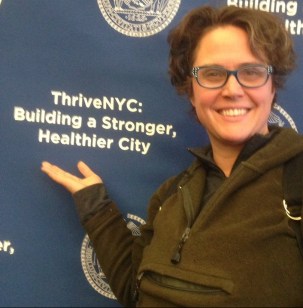
Sarah Elisabeth Brown asked questions, wrote answers, which should rise many discussions. We staretd by meeting with her about her process.
Tell us about yourself.
I grew up in Ann Arbor, Michigan and I am a product of a 70s alternative education. I remember writing the script for Annie in sixth grade by taking the synopsis off the back of the record album (yes, vinyl) and writing the scenes to fill it in from there. Theater has always been a serious part of my life. In high school, I attended North Carolina School of the Arts and graduated from Interlochen Arts Academy in Northern Michigan, otherwise known as “Fame in the Woods.” Afterwards, instead of going the path of a conservatory like most of my friends, I set out for the “real world” by way of Chicago with a theater company called Theater Oobleck, a company that wrote all their own work. When I expressed that I wanted to play more substantial roles, one of the writers sat me down and said, “Write your own play and we’ll do it.” I wrote my first short play for Theater Oobleck, then I went on to Hampshire College where I developed my degree, “Playwrighting: An Off-The-Desk Approach.” I used movement, improv, Theater of Images, and traditional playwrighting approaches to develop my own style of playwrighting. Afterwards, I created performances for Luna Sea, BUILD, Bearded Lady, and Theater Rhinoceros in San Francisco. Then later in New Mexico at the Santa Fe Playhouse and at Theaterwork. The last decade I’ve have spent writing and working in New York City participating with Workshop Theater, New York Women in Film and Television, and the Jacob Krueger Studio.
What inspired you to take on such an undertaking?
At the time, I was operating as the Playwright-in-Residence at a theater company called, Theaterwork in Santa Fe, New Mexico, run by a man named David Olsen. David had been mentoring me for several years on developing a story-collecting project called, “Spirit Club: Stories of Mental Discomfort and Healing,” which I developed as part of my role as a mental health advocate. That project was built from sixty interviews done with people who’d been diagnosed with serious mental health issues on the key stories in their lives. The Santa Fe Community Foundation had partially funded Spirit Club. They had been very happy with the project so when they put out a call for projects that helped build and empower the LGBTQ Community, our application to do another story collecting project was approved. This time, I took most of the interviews from my friends and people in the community that I knew. This time the interviews were about the key love stories of their lives, which was great fun.
In terms of that, once the idea is there, how do you write … what’s the creative process?
For awhile, I hoped that the interviews would lead to a storyline that I would then make into a traditional play with dialogue and a plot. At some point, it dawned on me that there was an elegance and simplicity to the stories themselves, plus because of the grant, we were on a tight timeline, so I began the work of honing the individual stories themselves as individual entities. Of the eight stories told in Lovebird Jamboree, there are some that are simply edited versions of what people told me in their interviews. Others are composites from several interviews that seemed to fit together and fill each other out. Still others were given fictional structures that accentuated the humor inherent in the piece, such as in Jell-O Salad and Game Time.

Steeped in reality like this, what realizations or epiphanies (if any) did it give to you?
There will always be a part of me that will envy trans men for their courage to step so fully into the masculine. Even though I’ve settled into a more feminine version of myself these days, I take a certain freedom and permission from them to explore my own boi side. I think this has helped me achieve more of a balance within my particular blend of masculine and feminine. Having come up queer or what I suppose would be called “pansexual” now, there were always trans people in my life, my community, and sometimes in my bed. However, having the intimate structure of the story collecting project, gave me access to a confessional side of things. I remember being particularly fascinated by the stories of trans men talking about being woman-born and the differences between their heterosexual experiences versus their lesbian ones, and then experiencing gay male type relationships as a man. I resonate with the idea of being a shape-shifter and have felt very fluid in both my gender and my sexuality, so these descriptions of one being experiencing all these kinds of relationships feels liberating and fascinating to me.
Who do you feel is the “audience” for this piece?
When I wrote it, the people who gave their stories came over and over again and there was a beautiful interplay between the actors and the people they played. Certainly, this is a play of celebration of untold love stories in the LGBTQ community. I’m hoping that now, twenty years later, the audience has expanded. Back then, you could never have a presidential candidate like Pete Buttigieg. Gay Marriage wasn’t even on the agenda. People thought it was too soon, too early, and that the world wasn’t ready. It was a different era. We weren’t trying to fit in as much as we were trying to create something different in relationships. Now that LGBTQ rights are much more broadly discussed in wider progressive politics, I think this is a good piece to come to for people in place of acceptance, who’d like to be brought deeper in. People who’d like a more intimate peak into lives of people who may be different from them. I can see this piece being a good educational experience for college age people.
What’s next?
I have a showcase of short plays coming up here in the city later this year.
 Drama Queens, a five-star arts journal focusing on female artists
Leave a comment