Samantha Hernandez Interview by Jen Bush
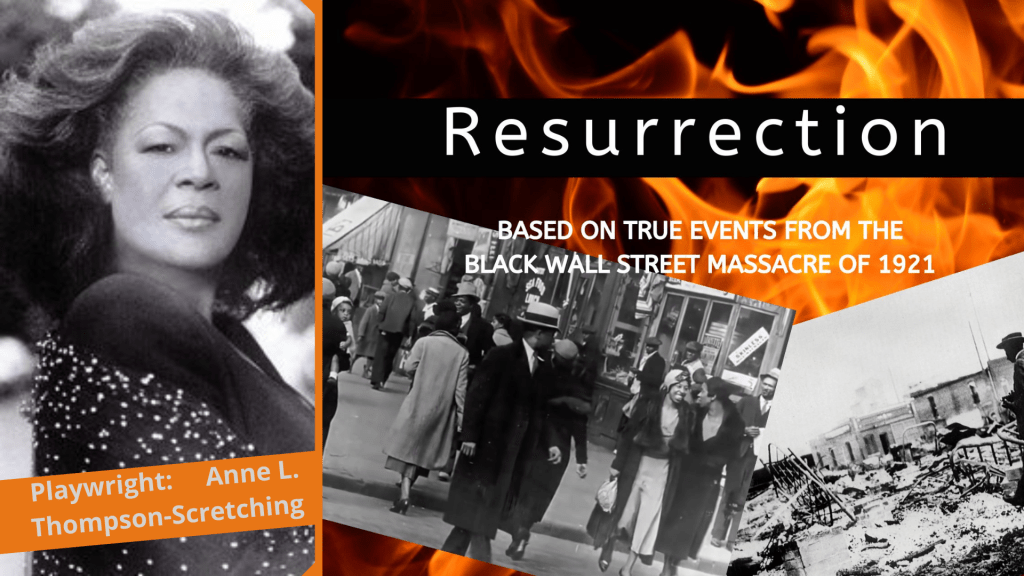
Resurrection will be playing at the landmark American Theatre of Actors from February 8-12. It tells of a dark and tragic incident in African American history in which an entire thriving community in Tulsa, Oklahoma perishes at the hands of an angry white mob.
Samantha Hernandez who plays Molly Brightwater was kind enough to share her thoughts on the production and her process for creating her character.

The creative process that Ms. Hernandez utilizes is a combination of research, collaboration, meditation and memorization. “My creative process is mostly preparation and meditation. Before I even tried to memorize the lines of Resurrection, I tried to imagine the kind of world Molly was living in. I said, “Ok. This play takes place in the 1920’s in Tulsa, Oklahoma. What do I already know about Tulsa, Oklahoma? What do I know about the race riots that took place? What do I know about Native American culture, specifically, the Chikasaw tribe?” I had to figure out where my starting point was, then build from there which meant actual research. I also spent time with Anne, the director, and fellow actor, Kevin Leonard. In the very beginning we worked through a few uncomfortable scenes for me, however, I understood that I had to get to a place where I no longer thought and saw myself as the person telling this story. I had to let go of any personal limitations I was placing on myself, which meant letting go of who I thought I was. Although it is true I have not gone through what Molly Brightwater’s character has gone through, I am still capable of sympathizing with her. So, I tried to use that in order to mold and put together some version of Molly with me in it. After getting to that place mentally, I learned the lines and the rest just came together while working and rehearsing with the cast. It also helps when everyone is so hardworking and talented. All in all, I think everyone’s creative process is different, for me, I like to do the work beforehand then just play, and having a well-structured team like this one, makes that possible.”
It is the hope of Ms. Hernandez that the audience will come away from this production with an emotional reaction. Given the context of the play, there is a wide range of both positive and negative emotions that the audience will potentially feel. “I am happy if at least one person leaves the theater feeling something, whether that be: rage, shock, disgust, sympathy, surprise, or frustration. Which I’m sure this play will do. There are a few times we break the fourth wall and interact with the audience. I think by doing that we add an element of surprise but in a way, also make the audience a part of the world we are creating on stage. In the duration of the three hours of this show, I think what people will certainly walk away with is the rawness of the words and the boldness of each character. The events that occurred in this play are what happened in real life and for a long time were kept from the public for hundreds of years. History was hidden and people tried to keep these people’s stories silenced but now here is Anne, writer and director, who is attempting to break that silence. The phenomenal thing about art is its ability to shed light on such a tragic, horrific, and sensitive event and do it in such a way that is poetic, expressive, and raw. This shameful time in American history should never be forgotten. The pain and suffering that occurred to the people of the Greenwood district in Tulsa, Oklahoma should no longer go unheard of. Their voices and their memories deserve to live on through time.”
Ms. Hernandez also had some takeaways from this. She was able to step into the past and discover some new perspectives on things. “Doing this show granted me the opportunity to, in a way, time travel. It’s about to be a year since I’ve had this script in my hands and every time I pick it up I either notice something I overlooked in the past, learn something entirely new, or just think about something with a different perspective and unlock a new understanding. For example, in act 1 when Ron is giving his closing monologue he says, “It turned out, they did it wrong. They didn’t know how to hang a nigger, they only knew how to hang a man.” The first time I heard this I didn’t understand what it meant. I pondered on it for a few rehearsals and after several conversations with a few cast members I was able to come up with my own interpretation. To me, Ron’s monologue is about how we’re all the same when we die. Although the white men thought they were killing the black men differently, they really weren’t. They bragged to know how to “hang a nigga”, but the rope did not break his neck, and ultimately Ron suffocated— proving they really didn’t know how to properly hang someone. In the end, they all died the same way, as men. I think that was one of the things I took away from this show. It gave me perspective and a personal learning experience.”
Due to the historical nature of the show, Ms. Hernandez did her due diligence in researching many aspects of the time period and the people who lived d uringthat time. “History was a big part of preparing my role. I had to read about the Chikasaw Native American tribe and research their dialect. I also looked into the music of the time and would listen to it in an attempt to get into a similar mindset.”
A play steeped in history can come with an added sense of responsibility for the actors to accurately represent that time in history with their interpretation of the characters. Ms. Hernandez took that responsibility seriously. “I do feel a sense of responsibility to represent this time in American history, because as a young Mexican-American woman I identify with Molly and know what it’s like to grow up with a traditional family/culture where your family’s view of you matters greatly. I sympathize with her. I also know that this is not the first time I have heard this narrative. I feel that there is this unspoken idea that goes on in other cultures where the white man is looked at as some kind of savior who will “rescue.” I think it is widely romanticized in films and culture. Although I have not personally experienced what Molly has lived through, I have been in love and so I try to imagine and invoke her confusion and anger after discovering what kind of monster she really fell for. I try to let those emotions guide me in order to tell this young girl’s story.”
We thank Ms. Hernandez for her time and we hope you take the time to see Resurrection at The American Theatre of Actors playing February 8-12.


 Drama Queens, a five-star arts journal focusing on female artists
Leave a comment