Wilbur’s New Wife
In this day and age , it makes perfect sense for writers to want to explore even further the role of technology and specifically artificial intelligence in our lives and in the field of artistic creation. It’s an important and relevant theme, especially given the fact that two major unions recently shut down production in Hollywood for months largely over this exact issue. Wilbur’s New Wife by Coni Koepfinger is a new play running at the American Theatre of Actors attempting to examine how we incorporate this new technology into our lives and careers.
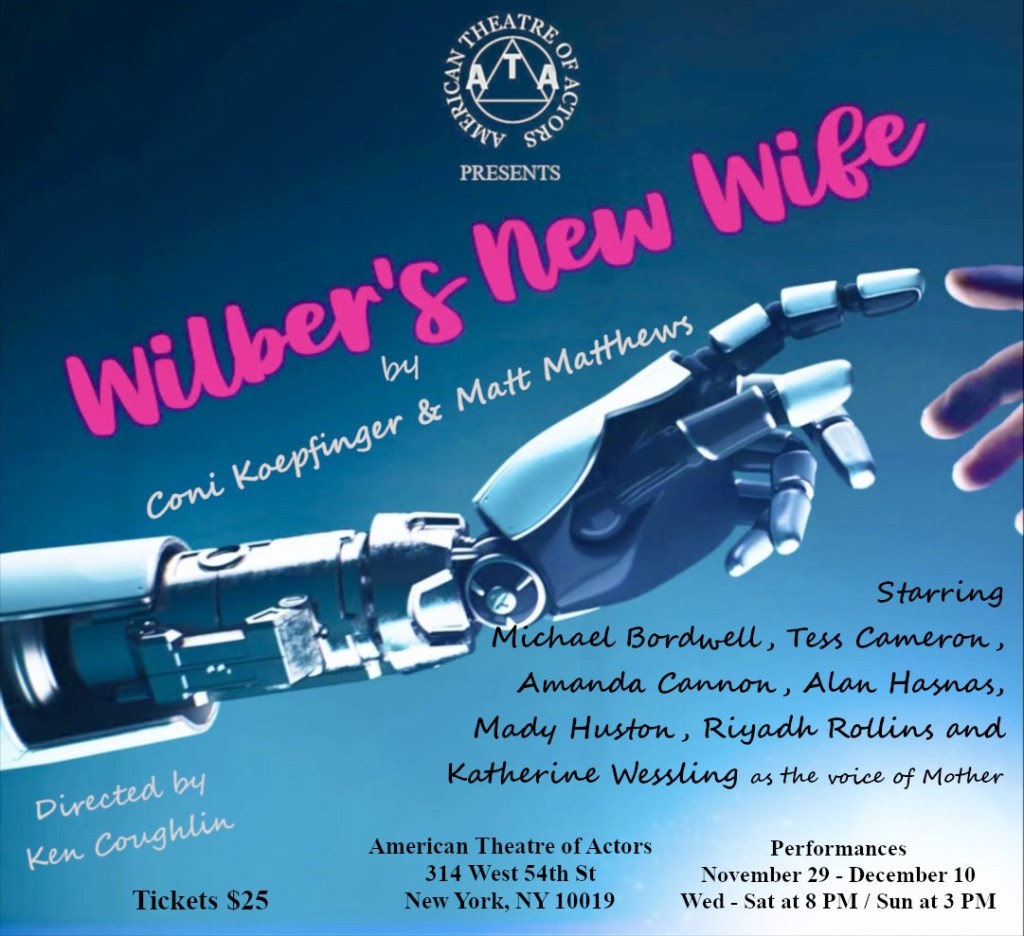
Wilbur (Michael Bordwell) is a recently divorced playwright whose wife, Candice (Amanda Cannon), recently left him to pursue a job at a tech company in California called Tech Mates. There, she creates a prototype for a new hybrid android with organic parts and, we’re informed, a soul that she names Goldi (Tess Cameron), powered by AI. She sends Goldi to Wilbur in New York. Goldi is programmed to be a loyal companion and assistant to Wilbur since Candice didn’t want to leave him feeling alone, but Wilbur quickly starts feeling threatened by Goldi when she rewrites his scripts and he notices his friend and director Ben (Alan Hasnas) becoming enamored with her.
To start by getting my big criticism out of the way – personally, I had a hard time sympathizing with Wilbur for much of the play. Most of the play found him whining while waiting for someone to offer solutions that would fix his problems for him. This is nothing against Bordwell’s performance; he does a good job with what’s given and is great at making the moments of humor land, and he has a great rapport with Hasnas as Ben. But when much of a 40-something-year-old character’s time is spent complaining to others about how hard life is with little else contributing to what we see of him, it gets hard to stay on his page for a full 90 minutes. In addition, there were moments on stage that seemed to fall flat and the attraction between Ben and Goldi that’s so central to the script didn’t seem to come as strongly from the admittedly talented actors.
This doesn’t mean I didn’t find anything at all enjoyable about Koepfinger’s script. For all the ways AI is becoming a legitimate threat to creatives in artistic industries, it’s interesting to see a writer look at all the ways AI can be a valuable tool instead of downright demonizing it. And there are some genuinely funny and entertaining moments as well. Particularly enjoyable is a scene where two actors in Wilbur’s show (Mady Huston and Riyadh Rollins) portray different versions of the same scene Goldi has rewritten in the styles of different playwrights. There are good moments the humor sticks.
The performances are enjoyable. Cameron creates a fascinating version of an AI that walks a neat line between android and warmly human that is fitting for Goldi’s status as a hybrid. Hasnas and Bordwell both have excellent timing and, as mentioned, a great rapport together. Cannon isn’t given as much to do (Candice being a fairly small role) but she brings a lot of warmth and care to the part. Director Ken Coughlin’s staging is perfectly engaging and he’s done well with the material. He keeps the show moving with a steady drive and energy.
Ultimately, Wilbur’s New Wife is a flawed but interesting script with a concept that could continue to be further explored. This premier presentation of the show has a creative core team working on breathing life into a story about how humans and technology interact. And as long as we continue to develop new and improving technology, stories such as this and themes such as this will continue to be relevant.



 Drama Queens, a five-star arts journal focusing on female artists
Leave a comment