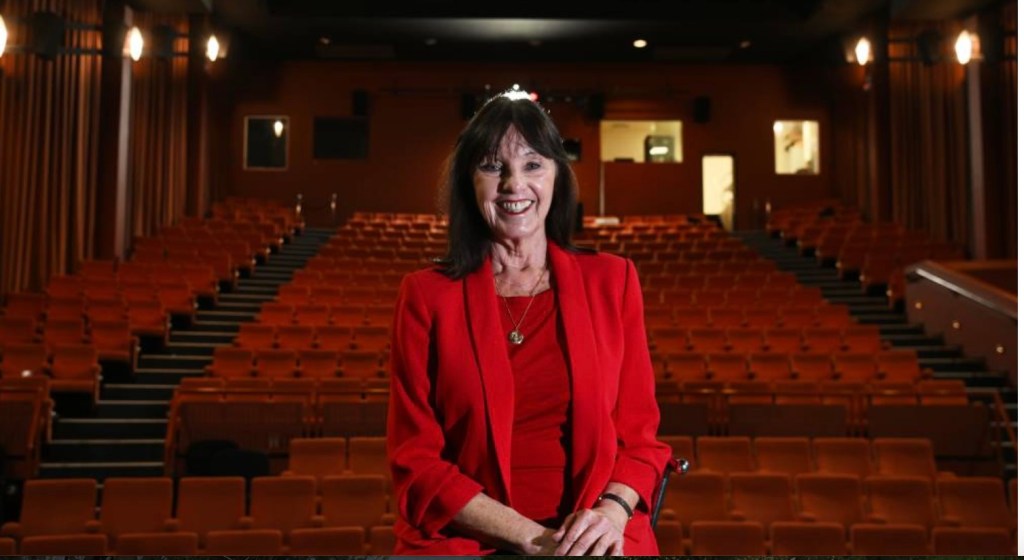
The Drama Book Shop presents, in association with Jay Michaels Global Communications, a series of discussions with prominent authors in the arts world. Just prior to Valentine’s Day, Christine McClure and her new book, “Drama For Teen Actors” will be featured. Tuesday, February 13 · 7:30 – 8:30pm EST, Ms. McClure will share the journey of six professional teenage actors as they study drama in an eight-week course. The Drama Book Shop is located at 266 West 39th Street New York City.
RSVP HERE

Drama for Teen Actors demonstrates how teen actors create dramatic roles through exercises for emotions, character improvisation, and scene work. After that, the actors will reveal what they worked on and what they discovered—followed by class questions, discussions about their acting experiences, and, finally, the author’s feedback and guidance. This is done in a safe environment where students feel free to make mistakes, learn without being judged, support their dreams, and share their love of acting. Those who train in this method will be educated for life because they know how to construct a role. on-set coaching has contributed to the success of notable films, including “Contagion.” McClure’s expertise lies in the Stanislavski/Strasberg method, focusing on motivation, improvisation, and character development. As an actress herself, known by the stage name Elli Maclure, she has worked with renowned directors like John Cassavetes and acted alongside celebrated figures like Gena Rowlands.
After doing Shakespeare roles at school, which is how she fell in love with acting, Christine McClure. studied at the National Institute of Dramatic Art, Sydney, Australia, before enbarking on her professional acting career. Under the stage name of Elli Maclure, she played lead roles in feature films, television, and theater. Starring in series, numerous guest appearances and pilots in Australia, Europe, and supporting roles in the U.S., “Elli” worked with directors – John Cassavetes, Peter Bogdanovich, Francis Ford Coppola, Peter Weir, Simon Wincer, Tim Burstall, and with actors Gena Rowlands, in an Italian feature with Alberto Sordi and Claudia Cardinale, and a Spanish feature with Antonio Ferrandis. In 1989, while studying with the late Master Teacher, John Lehne, of The Actors Studio, under his guidance she started teaching acting classes and privately coaching young professional actors in Los Angeles (under her real name, Christine McClure). And have continued this profession for over thirty years. “It was John’s teaching that not only gave me extraordinary new insights into the acting process, but I felt passionate about the art of acting all over again, and have since devoted my life to teaching,” the celebrated author said.
Since the 90s, her acting students have received Best Actress and Actor Awards and Nominations: Oscars, BAFTA’s, Daytime Emmys, Hollywood’s Young Artists Awards, Young Stars, MTV, Critics Choice. Students book lead and supporting roles in movies, and in television – series regulars, episodic guests, pilots, MOWs, and soaps. She has worked with such Oscar-winning and nominated talents as actors – Matt Damon, Robert DeNiro, Mel Gibson, Robin Williams, Tom Cruise, Nicole Kidman, Jeff Bridges, George Clooney to name a few … And with A-list directors – Sofia Coppola, Steven Soderbergh, Stanley Kubrick, Nancy Myers, Tony Scott, Robert Zemeckis, the Coen brothers, and more.
We met with the distinguished Ms. McClure to learn more about her, her technique, and her book.
What led you to become a writer?
From the beginning of my acting career some movie directors suggested I should write. Mainly when people got to know how I had grown up in a convent boarding school from the age of six, what happened with my parents, and to me in my life since. About twenty years ago I woke up with an idea for a feature movie – about a teenage girl and a crisis she faced being abused. So, I wrote a screenplay, and went on a journey with her character, Lily. The story is set in the convent and we see how she is helped through the abuse she suffered by a young enlightened nun. It is part true story, part imagination. This screenplay, Rules of Silence, has had four options both in the US, and was recently packaged in Australia but not yet been in production. I’ve written other screenplays and during my teaching career have written a lot of exercises on acting for my classes. Drama for Teen Actors, is my first non-fiction book. The book takes the reader on a journey with six professional teenage actors as they study drama in an eight-week course. The Actors range in age from fourteen to seventeen—the perfect age for training and transitioning to adult acting. The focus being … acting on screen. In Drama for Teen Actors, you’ll read about how teen actors create dramatic roles through exercise work, character improvisation, and scene work. After that, the actors will reveal what they worked on, their goals, and their insights—followed by class questions, discussions about their acting experiences and, finally, my feedback and guidance. We do this in a safe environment where students feel free to make mistakes, learn without being judged, support their dreams, and share their love of acting. Those who train in this method will be educated for life because they know how to construct a role. I want the reader to feel that they have a literal front-row seat in these dramatic acting classes. The questions the actors ask in the classes are questions that the reader might have in their minds and need answers to. The book is not just explanation, I write about behavior and demonstrate that on the page as if we are seeing an actor work, plus after that there is an interactive conversation with the actors and the teacher (the author.) It is my hope that reading what these talented teens accomplish will inspire all young actors to develop the skills they need to meet the screen industry’s demands and achieve their own goal of becoming great dramatic actors. Drama for Teen Actors is independently published on Amazon. It is also for sale at the Drama Book Shop in New York. It is at the Drama Book Shop where I will be doing an event, Tuesday, February 13th, to promote the book. I would love all actors of all ages, teachers, parents, friends of actors, agents, managers and all creatives in the movie industry to come to event. Here’s a review that I think says a lot about the book …
Robert Burgos:
“Christine McClure’s passion for teaching teen actors, along with her deep understanding of the issues facing young actors, makes “Drama for Teen Actors” a must read for teen actors and teachers alike. Her knowledge and respect for the art and craft of acting, and the simplicity and clarity of her approach, make for a much-needed, uncomplicated step-by-step program. It is a great start for teens preparing for careers as actors.”
Robert Burgos has coached actors, and directors,
on films for most of the major studios,
as well as taught Directing Actors at UCLA, LMU
and Chapman University.
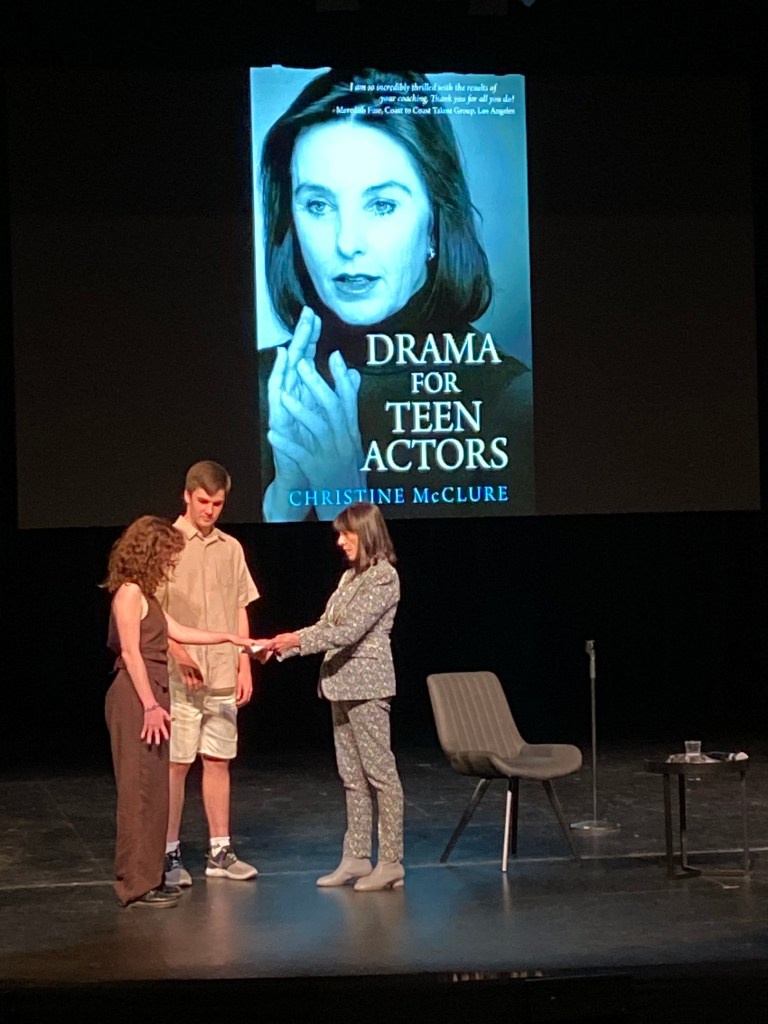
What’s your creative process? Do you know what’s going to happen all the way through before you sit down to write, or does it happen organically?
I have an overall idea of what is might happen, then most of what I write happens organically out of the overall concept. When I decided to write this book, I was told I needed a point of view, and to think about who I was talking to. So, the only way I could do that was to imagine I’m teaching a class. I decided on drama because that is what I am known for in Los Angeles. Agents, casting directors and parents send young actors to me when the actor needs real and in-depth emotional work. This ability comes from my training in the “method.” Although I believe there is not just one method, but any method that brings out the best in the actor. I decided to write about teens because that is the perfect age to train an actor for an upcoming adult career. What I have to say in the book is for actors who want to develop an imaginative and a creative approach to acting- to learn how to motivate sides of themselves to play the roles the screen industry demands of them now and in the future; to have preparations to create the frame of mind of the character when shooting out of sequence; and how to work alone without rehearsals, as is the way of screen acting, and so the actor is ready on day one of the shoot. So, I began writing with something I remembered saying in a meeting. “MEREDITH FINE, A LEADING AGENT FOR YOUNG ACTORS IN Los Angeles, once asked me, “How do you work with the actors?” I told her, “I find a side to the actor they can use to play the character. That makes them real in the role.”
After that conversation, I decided to write this book based on my experience and an upcoming, eight-week dramatic acting class with six professional teen actors: Maya, Josh, Asia, Deion, Hayley, and Jacob.
I decided to base overall ideas of the session on the answer I gave Meredith – finding sides to the self to play a role. To start the first class, I gave the actors, three boys and three girls, an example of a 14-year-old girl experimenting with behavior to be Ophelia going mad in the last scenes of Shakespeare’s Hamlet. From that example the actors did a physical action exercise, and PS the boys did not have to play a girl, just do the physical action I gave them all. After seeing each actor work, I could see what each actor needed to work on to improve their skills. This was the springboard I needed to cover the subjects I wanted to write about in the book–Chapter 1 Character Building from the Self. Chapter 2 Being at Ease on Camera. Chapter 3 Incorporating the Five Senses. Chapter 4 Motivating Emotional Responses. Chapter 5 Character Behavior Improvisation. Chapter 6 Character Backstory Improvisation. Chapter 7 Working on a Movie Scene. Chapter 8 A Scene on Camera. In each chapter, one of the six actors has a leading role to develop the skill they need, other actors participate to help when needed. As I wrote I could hear my voice teaching. I visualized each of the actors working as if in an acting class working in front of me on a classroom stage which is eye level so I could see the actors in close-up. After their exercise finished, I could hear the actors speaking about their work that they just demonstrated. I then wrote our discussions, the actors’ questions, and what they revealed about their experiences acting in class and professionally. That was my writing process before finding an editor.
Look for Part II in www.Showtones.com

 Drama Queens, a five-star arts journal focusing on female artists
Leave a comment