[Continued from ArtiumOmni.com]
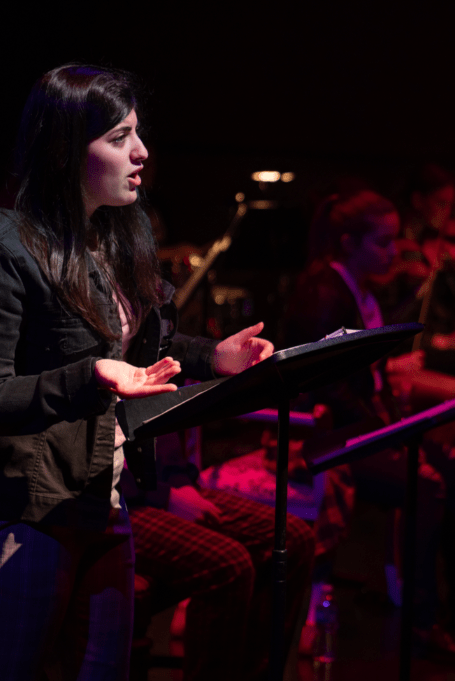
After hearing about her sci-fi thriller, we moved to her stage works including her innovative new musical. LOUR YASIN had much to say about that.
Let’s focus on your other talents: AREA D … stunning… what was the inspiration for it?
AREA D came about as a wild idea to shake up the musical theater scene and have a bit of fun along the way. You know, I always wanted to write a musical that could rival The Band’s Visit, just as a joke, really. But then, as I started diving into it, I realized I wanted to do something more than just poke fun. I wanted to blend Middle Eastern music, Broadway, and pop in a way that nobody had ever done before and explore the world of music and politics in a way no one did before.
The real inspiration hit me when Israel hosted Eurovision in 2019. The news was everywhere, this glitzy competition that’s not just about music but also national pride and bringing home that glass microphone. It’s kinda absurd and whimsical, yet totally political at the same time, regardless of how many times the competition denies it. But here’s the kicker: Palestinians weren’t allowed to compete. It was just one of those things you sort of tune out because it’s the same old story. But then I started thinking, what if they were? Even better, what if they were selected?
That’s where AREA D comes in. It’s not your typical musical where you’re on the edge of your seat wondering if they’ll make it to the competition. No, it’s more about flipping the script and subverting expectations. See, whether that band wins or not, that glass microphone isn’t going back to the state that submitted it. So, what’s at stake there? Why would they even send in a Palestinian band to represent them? I mean, imagine a Palestinian pop-punk Broadway musical with a bunch of rockers from different parts of the country, not even caring about winning Eurovision. It’s all about the adventure, the unexpected twists, and the moments that make you go, “Wait, did that just happen?”
So, I decided to turn this wild idea into my graduation thesis. It was the perfect excuse to spend my senior year working on something I was truly passionate about. And let me tell you, electrifying an Oud and running it through some guitar pedals? That was a blast. AREA D is all about pushing boundaries, breaking stereotypes, and having a good time doing it.
AREA D dives deep into these questions, exploring themes of identity, belonging, and the power of music to demolish borders. Not in the unifying sense, that’s boring. But more so in breaking down the borders and walls that uphold certain ideologies and stereotypes. It’s a wild ride filled with unexpected twists and turns, and I couldn’t be more excited to share it with the world. This musical isn’t just about entertainment; it’s about starting conversations and challenging perceptions. And I think that’s something we could all use a little more of these days.
“Creator of the first Palestinian pop-punk musical and pioneer in music fusion. I was the first composer to write and star in a Pop/Punk Palestinian musical.” AMAZING! … what is your mission in doing this now?
My mission in creating the first Palestinian pop-punk musical and pioneering music fusion goes beyond just making music. It’s about representation and empowerment. Growing up, I didn’t see myself or my community reflected in mainstream media, especially in the realm of musical theater. Often, I’m told I’m not Middle Eastern/BIPOC enough for BIPOC roles or not white enough for white roles, existing in a gray area. The closest we’ve come to representation in theater is The Band’s Visit, and even that doesn’t suffice. I wanted to create something fresh, musically, and a story that doesn’t reduce people from the SWANA region to stereotypes.
So, I decided to take matters into my own hands. By blending elements of pop-punk with Palestinian culture, I aimed to create something entirely new and authentic. It’s about reclaiming our narrative and showcasing the richness and diversity of SWANA (Southwest Asian and North African) cultures.
Through this musical journey, my aim is to provide more roles for SWANA performers and break the status quo, humanizing people. All art is political, inherently carrying an opinion. The musical theater scene is predominantly white and cookie-cutter. We need change, and given the current state of the world, this musical is needed more than ever.
Ultimately, my goal is to inspire other artists from similar backgrounds to embrace their uniqueness and create fearlessly. It’s about fostering a sense of pride and belonging within our community while also inviting others to appreciate the beauty of our culture through the universal language of music.
What made you decide to bring your style of work to the U.S.?
Bringing my style of work to the U.S. just felt like the next step, you know? Back home in Palestine, it was hard to find opportunities because there was no supportive environment to create the arts. There was a massive discrepancy between the funding that Palestinian theater and music conservatories would get versus the Israeli ones, making it even more challenging to pursue a career in the arts.
The conservatories and theaters where I trained were often struggling to stay afloat, with limited resources and little government support. Seeing my teachers from outside the country being denied visa renewals left and right was disheartening. I wanted to get a proper education in performance and writing, a privilege that many people don’t recognize.
So, I figured heading to the U.S. would give me that chance to learn and grow in a stable environment. My goal was to come to the U.S. and make a difference, to shake things up and send waves through the community. I wanted to give more representation and subvert the genres, bringing fresh perspectives and narratives to the forefront.
At first, I just wanted to be a performer, plain and simple. But as I got deeper into my craft, I realized there was more to it. I wanted to represent performers like me, from SWANA communities, who weren’t getting much of a spotlight in mainstream media. And hey, the U.S. seemed like the perfect place to make that happen.
Plus, the U.S. has this amazing mix of cultures and creative energy that’s just infectious. I knew bringing my own background and style here could add something fresh to the scene. So, here I am, ready to make some waves and hopefully shake things up a bit.
[conclusion in showtones.com]
 Drama Queens, a five-star arts journal focusing on female artists
Leave a comment